
ZEOCAT-3D
Description
What if you could 3D-print a catalyst that turns methane, a harmful greenhouse gas when released into the atmosphere, into high-value products and efficiently made hydrogen fuel? All of this is now possible and, importantly, inexpensive thanks to ZEOCAT-3D’s breakthrough technology.
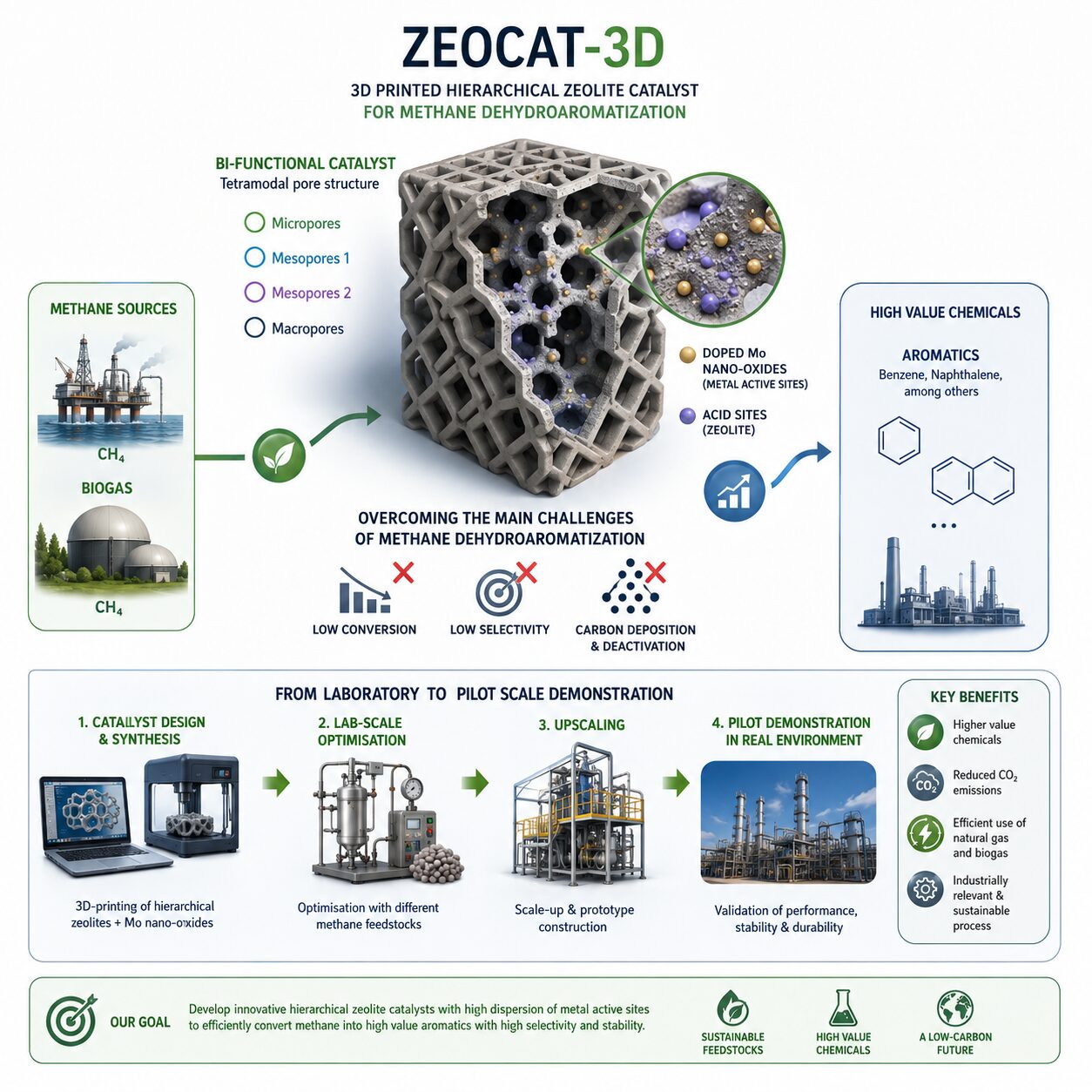
The EU-funded ZEOCAT-3D project developed a new technology for directly converting methane into high-value aromatic compounds – benzene and naphthalene – and hydrogen. The new process can more efficiently convert methane from stranded sources into shippable liquid fuels and could also help the industry reduce greenhouse gas emissions.
An alternative, single-step gas-to-liquids process
The conversion of methane – the principal component of natural gas and biogas – to fuels and starting materials for the chemical industry is called gas-to-liquids. Most technologies involve converting methane and carbon dioxide into a mixture of hydrogen molecules and carbon monoxide, so-called syngas. From syngas, various products such as olefins, gasoline, diesel and oxygenates can be obtained using the well-established Fischer-Tropsch process. Alternatively, syngas can be converted into synthetic fuels and other important products through methanol-to-gasoline or methanol-to-olefin processes. “These commercial approaches are feasible at large scales but involve multiple steps for methane conversion. Until now, no direct processes have been developed at an industrial scale and commercialised,” remarks project coordinator Maria Tripiana. What’s more, syngas conversion is energy-intensive and expensive, while oxygen needs to be removed from syngas before being converted into hydrocarbons. “In ZEOCAT-3D, we proposed a more viable and environmentally friendly method for methane conversion that eliminates intermediate steps. We used a chemical reaction called dehydroaromatisation that directly converts methane into aromatic compounds and hydrogen,” explains Tripiana. “As alternatives to oil, benzene and naphthalene are very interesting raw materials for the production of liquid fuels and high-value chemicals. Furthermore, hydrogen is extracted as a coproduct, which could serve for ammonia production or in fuel cells.”
The keys to success: 3D-printed catalysts and advanced reactor design
Existing catalysts used to speed up methane dehydroaromatisation are not very efficient. ZEOCAT-3D’s novel catalysts tackled two big challenges standing in the way of this chemical reaction: difficulty in obtaining the desired high-value compounds as unwanted by-products are often formed (poor selectivity), and quick catalyst deactivation owing to carbon deposition in the catalyst pores, a process known as coking. “Using hierarchical modelling and simulations, we showed that if you control the nanoparticle size, morphology and degree of agglomeration, coking is no longer a threat,” stresses Tripiana. “In our case, we used digital light processing to synthesise 3D zeolites with higher catalytic activity. We were the first to demonstrate novel hierarchical zeolites embedding four distinct pore structures. Bringing together two or more zeolite pore topologies at the mesoscale offers the opportunity to optimise nanoparticle transport and selective conversion of reaction intermediates,” adds Tripiana. The catalytic reactor prototype integrated a purification system yielding methane above 95 % purity, a hydrogen-selective ceramic membrane and a filtration system removing particulates entrained in the product flow (either carbonaceous or ash). This compact, modular reactor now treats 4 normal litres per minute of gas flow and produces 40 grams per hour of high-value products. ZEOCAT-3D provided new insights into the design of highly efficient catalysts and reactors for the production of valuable products, potentially reducing greenhouse gas emissions, which could be a building block for a sustainable circular economy. ZEOCAT-3D outcomes will guide future projects in bringing the proposed technology to a higher maturity level.
Résultats
The conversion of methane – the principal component of natural gas and biogas – to fuels and starting materials for the chemical industry is called gas-to-liquids. Most technologies involve converting methane and carbon dioxide into a mixture of hydrogen molecules and carbon monoxide, so-called syngas. From syngas, various products such as olefins, gasoline, diesel and oxygenates can be obtained using the well-established Fischer-Tropsch process. Alternatively, syngas can be converted into synthetic fuels and other important products through methanol-to-gasoline or methanol-to-olefin processes.
“These commercial approaches are feasible at large scales but involve multiple steps for methane conversion. Until now, no direct processes have been developed at an industrial scale and commercialised,” remarks project coordinator Maria Tripiana. What’s more, syngas conversion is energy-intensive and expensive, while oxygen needs to be removed from syngas before being converted into hydrocarbons.
“In ZEOCAT-3D, we proposed a more viable and environmentally friendly method for methane conversion that eliminates intermediate steps. We used a chemical reaction called dehydroaromatisation that directly converts methane into aromatic compounds and hydrogen,” explains Tripiana. “As alternatives to oil, benzene and naphthalene are very interesting raw materials for the production of liquid fuels and high-value chemicals. Furthermore, hydrogen is extracted as a coproduct, which could serve for ammonia production or in fuel cells.”
- . 2022. "Experimental Quantification of Gas Dispersion in 3D-Printed Logpile Structures Using a Noninvasive Infrared Transmission Technique". ACS Engineering Au 2(3): 236-247. DOI .
- . 2022. "How do the products in methane dehydroaromatization impact the distinct stages of the reaction?". APPLIED CATALYSIS B-ENVIRONMENTAL 309: 121274. DOI HAL .
- . 2022. "Review on Additive Manufacturing of Catalysts and Sorbents and the Potential for Process Intensification". Frontiers in Chemical Engineering 4: 834547. DOI .
- . 2022. "Solutions of the mass continuity equation in hollow fibers for fully developed flow with some notes on the Lévêque correlation". Carbon Capture Science & Technology 2: 100027. DOI .
- . 2021. "A 3D-1D model for the simulation of plant-scale chemical reactors". DOI .
- . 2021. "Transformation of Dilute Ethylene at High Temperature on Micro- and Nano-Sized H-ZSM-5 Zeolites". Catalysts 11(2): 282. DOI HAL .