
Sun2Chem
Description
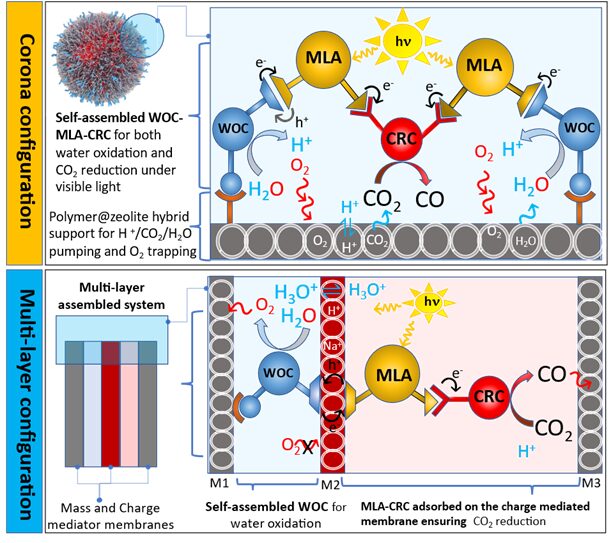
SunToChems’ project that aims, via a multidisciplinary team of Postdocs and research engineers, to develop a new approach for building a multi-components photocatalysts system by self-assembling molecular approach. The key of the success of SuntoChem project will be ensured by the combination of the molecular modeling with the experimental investigations at different time scales. The combination of modelling with synthesis strategy and advanced characterization, is therefore the guidelines of my group to design a new generation of sustainable artificial photosynthesis catalysts with enhanced performance. The first results of the project are very promising, showing e.g. the advantages of the preparation of the organometallic complexes based photocatalysts on zeolite (shell/core type form) for enhancing photocatalytic reduction of CO2. Zeolite nanoparticles play as an active support to concentrate the reactant (CO2/H2O) and immobilize the photocatalyst. A demand of patent for protecting the building block monomer-based ligands, synthesized for preparing the catalysts is in preparation by the CNRS. On another hand, the self assemblig of the Photosensitizer with a cocatalyst can shorten the energy/charge transfer enhancing then the overal yield of the photocatalytic reaction of CO2. The results obtained from this project will serve for designig self-assembled multi-compenent systems combining photocatalysts moitey for OWS and other for CRC.
Objectifs
Multi-actor collaboration has been engaged from the onset of the project to define the specifications on simple and complex photocatalytic composites, metal oxide photoelectrodes and solar-driven catalytic systems for ethylene production, deciding parameters for evaluation of project goal. This step was crucial to ensure the development of each individual component.
Different synthesis approaches have been investigated for developing the most efficient concept for light harvesting and charge carriers separation (e.g. colloidal protective methods, photodeposition, Impregnation/chemical reduction, aiming at controlling the shape, the morphology, the content and the composition). The influence of total M content, of M1/M2 ratio, of M nanoparticle size distribution and dispersion onto SCs are investigated as well. In task 2.4 gas-phase photocatalytic CO2 reduction has been performed under continuous CO2 flow in the set-up, allowing to follow kinetics of CO2 reduction and products formation.
In parallel, BiVO4 photoanodes and Cu2O photocathodes have been synthesised and thoroughly characterised for the tandem device to be further developed. Nanoparticulated and nanostructured BiVO4 photoelectrodes have been grown and studied for both, oxygen evolution reaction (OER) and hole scavenger oxidation. BiVO4 nanoparticles have been prepared by both batch and continuous-flow processes at low temperatures, in an aqueous medium, using inexpensive precursors. Additionally, the continuous flow synthesis is suitable to scale-up the synthesis and the photoelectrodes. Nanostructured BiVO4 photoanodes have been produced and optimised by two different electrodeposition (ED) methods targeting photocurrent of 7 mA·cm-2. In line with the electrodeposited photoelectrodes, different photoanodes were prepared where nanorods of TiO2 and WO3 were previously grown, in order to obtain different heterostructures with BiVO4. On the other hand, efficient Cu2O photocathodes + CO2 RR catalyst have been prepared through the optimisation of a Cu2O buried junction. To sum up, stable photoelectrodes for the tandem PEC device have been synthesised through different optimise processes and the progress in the performance of the photocathode and the photoanode are in the range of the targeted ones ( ̴4.5 mA·cm-2 at 1.23 V vs RHE for BiVO4 and ̴6 mA·cm-2 at 0 V vs RHE for Cu2O) and mechanistic studies have been performed to understand the limiting factors of such photoelectrodes.
On this basis, the PC systems and the PEC systems have been gathered to design a solar driven catalytic system. For CO2 RR catalyst, we have used Cu metal modified with Chloride salt electrolyte, achieving electrochemical ethylene production Faradaic efficiency of > 70%. Using this catalyst, we realised photocathode – CO2 RR catalyst device. Initially, Cu2O based device were chosen as light absorber, later we changed it to Lead halide perovskite-based device, which achieved both sufficient current density and voltage (20 mA/cm2 and 1.0 V). Later, PSC-Cu photocathode achieved ethylene production Faradaic efficiency around 15% with partial photocurrent density around 1.5 mA/cm2 at -0.4 VRHE.
Each single components have firther been integrated into a single fuctional devices for performing stability assessment. The stability of the electrodes was extensively investigated using spectroelectrochemical techniques, providing deeper insights into their degradation mechanisms. Additionally, thorough analyses and simulations were conducted on how the components were assembled.
To support and anticipate futur market uptake of SUN2CHEM solution, an extensive work has been carried out regarding the environmental Life Cycle Analysis, Life Cycle Costs and Social Acceptance. In addition, a detailed market analysis and roadmap for upscaling project results has also been developed.
Résultats
SUN2CHEM project has achieved fascinating results that are paving the way for future technological development.
In particular, the following progresses have been achieved:
– 4% efficiency for a 1 cm² PEC systems for solar-to-fuel, reaching 1% when upscaled at 50 cm²;
– a record breaking efficiency of 3,3% for solar to ethylene in PEC system;
– production rate of ethylene of 0.3 umol cm-2 hr-1;
– deveopment of several prototypes, including 2 systems for on-site production of ethylene;
– increased energy security f the end-users by 75%;
– an anticipated reduction of CO2 emissions compared to standard methods to produce ethylene at horizon 2050 by 70%.

- . 2024. "Cooperative Effects Drive Water Oxidation Catalysis in Cobalt Electrocatalysts through the Destabilization of Intermediates". Journal of the American Chemical Society 146(13): 8915-8927. DOI .
- . 2024. "Proactive understanding of the multi-level stakeholder acceptance of a novel renewable energy technology: Chemical storage of solar energy". Energy Research & Social Science 108: 103370. DOI .
- . 2022. "A Parametric Study of the Crystal Phases on Au/TiO2 Photocatalysts for CO2 Gas-Phase Reduction in the Presence of Water". Catalysts 12(12): 1623. DOI HAL .
- . 2022. "Challenges and prospects of plasmonic metasurfaces for photothermal catalysis". Nanophotonics 11(13): 3035-3056. DOI .
- . 2022. "Defect engineering over anisotropic brookite toward substrate-specific photo-oxidation of alcohols". Chem Catalysis 2(5): 1177-1190. DOI .
- . 2022. "Effect of Band Bending in Photoactive MOF-Based Heterojunctions". ACS Applied Materials & Interfaces 14(17): 19342-19352. DOI .
- . 2022. "Electrocatalytic CO2 Reduction: Role of the Cross-Talk at Organic-Inorganic Interfaces". DOI .
- . 2022. "Morphology and Light‐Dependent Spatial Distribution of Spin Defects in Carbon Nitride". Angewandte Chemie 134(43): e202210640. DOI .
- . 2022. "The role of crystal facets and disorder on photo-electrosynthesis". Nanoscale 14(42): 15596-15606. DOI .
- . 2021. "Design of dye-sensitized TiO2 materials for photocatalytic hydrogen production: light and shadow". Journal of Physics: Energy 3(3): 031001. DOI .
- . 2021. "Electrocatalytic CO2 reduction: role of the cross-talk at nano-carbon interfaces". Energy & Environmental Science 14(11): 5816-5833. DOI .
- . 2021. "Facile Surfactant-Assisted Synthesis of BiVO4 Nanoparticulate Films for Solar Water Splitting". Catalysts 11(10): 1244. DOI .
- . 2021. "Photodoping and Fast Charge Extraction in Ionic Carbon Nitride Photoanodes". Advanced Functional Materials 31(45): 2105369. DOI .
- . 2021. "Plasmonic Au-based junctions onto TiO2, gC3N4, and TiO2-gC3N4 systems for photocatalytic hydrogen production: Fundamentals and challenges". Renewable and Sustainable Energy Reviews 149: 111095. DOI HAL .
- . 2021. "Well-defined Cu2 O photocatalysts for solar fuels and chemicals". Journal of Materials Chemistry A 9(10): 5915-5951. DOI .