
PIONEER
Description
Le recyclage et la conversion du CO2 en carburants plus écologiques grâce à la catalyse du plasma
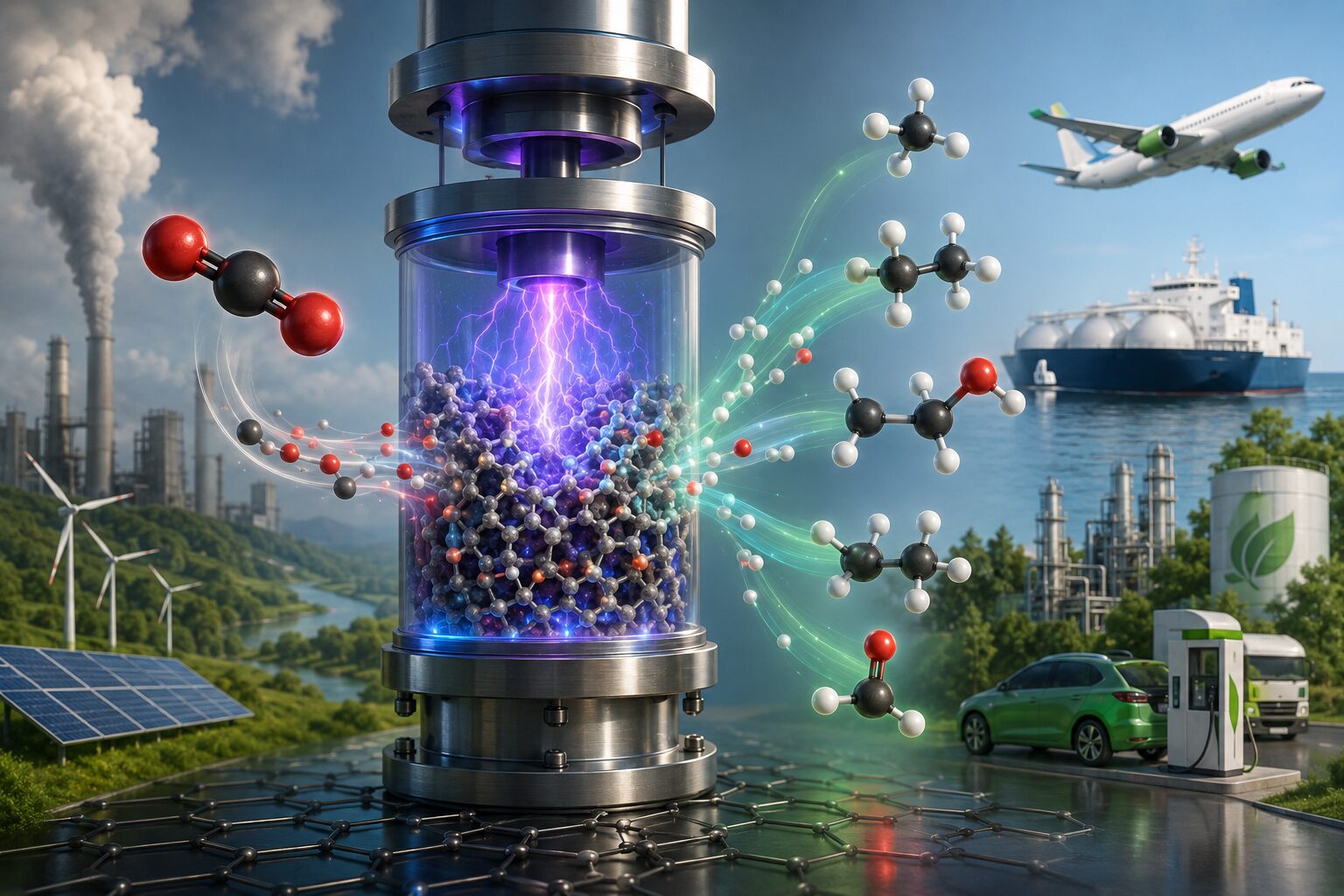
Il est essentiel de réduire les émissions de CO2 afin de ralentir le changement climatique, mais ce processus prend du temps pour toutes sortes de raisons. Capter le CO2 émis représente une autre solution pour diminuer les émissions qui atteignent l’atmosphère. Recycler ce CO2 est encore mieux. Les plasmas froids sont des gaz faiblement ionisés dotés d’une petite proportion d’électrons très énergétiques capables d’initier des réactions chimiques avec peu d’énergie. Associer des plasmas à des catalyseurs permettra d’accélérer la cinétique des réactions afin de surmonter les obstacles actuels. Avec le soutien du programme Actions Marie Skłodowska-Curie, le projet PIONEER développe des systèmes de couplage plasma/catalyse innovants pour convertir le CO2 en hydrogène, en méthane, en éthanol ou en méthanol.
Objectifs
The main objective of the present ITN project is the formation of a new generation of experts in the subject of CO2
valorization using plasma-catalytic coupled processes. Plasma intensification of CO2 valorization processes, such as CO2
hydrogenation and dry reforming of methane, can greatly contribute to the stabilization of CO2 concentration in our
atmosphere through the production of synthetic fuels that will be involved in overall zero or near zero emission cycles. This
alternative utilization of yet C-based fuels will play an important role in our transition to a 100% renewable future. Chemical
and thermochemical CO2 valorization processes are hindered by very slow reaction kinetics. Catalysts are often used but,
most of the time, they either are not enough, or their utilization is not feasible under real operation conditions. The use of
plasmas in combination with a well-designed catalyst can turn this sluggish CO2 valorization processes feasible. There is
however a complete lack of knowledge about almost every aspect of this plasma-catalysis coupling. Research efforts will be
then directed towards the understanding of CO2 plasmas, their interaction with solid catalytic surfaces, the formation of
excited species and the fundamentals of the reaction mechanisms involved. Different plasmas and different catalysts are
needed. Novel reactor concepts need to be found. The PhD topics cover many different scientific disciplines: from the physics of plasmas to the physicochemical characterization of solid surfaces and catalysis. The students will be instructed in several fields, not only considering science but also other important skills, such as soft skills training, as well as specific
formation on managing, marketing and business skills along the duration of this project. To cloture this project a
European conference on Plasma Catalysis for CO2 Valorization and Green Chemistry is foreseen.

- . 2023. "Influence of oxygen on the ro-vibrational kinetics of a non-equilibrium discharge in CO2 –O2 mixtures". Plasma Sources Science and Technology 32(1): 015004. DOI .
- . 2023. "Study of vibrational kinetics of CO2 and CO in CO2 –O2 plasmas under non-equilibrium conditions". Plasma Sources Science and Technology 32(2): 024001. DOI HAL .
- . 2022. "Absolute OH density measurements in a CO2 –H2 O glow discharge by laser-induced fluorescence spectroscopy". Plasma Sources Science and Technology 31(5): 055002. DOI .
- . 2022. "Carbon bed post-plasma to enhance the CO2 conversion and remove O2 from the product stream". Chemical Engineering Journal 442: 136268. DOI .
- . 2022. "Crosstalk-Free Excitation Scheme for Quantitative OH Laser-Induced Fluorescence in Environments Containing Excited CO". Applied Spectroscopy 76(7): 851-855. DOI .
- . 2022. "Electron-neutral collision cross sections for H2 O: I. Complete and consistent set". Journal of Physics D: Applied Physics 55(44): 445205. DOI .
- . 2022. "Insights into the limitations to vibrational excitation of CO2 : validation of a kinetic model with pulsed glow discharge experiments". Plasma Sources Science and Technology 31(7): 074003. DOI .
- . 2022. "Observation of surface species in plasma-catalytic dry reforming of methane in a novel atmospheric pressure dielectric barrier discharge in situ IR cell". Catalysis Science & Technology: 10.1039.D2CY00311B. DOI HAL .
- . 2022. "On the influence of the preparation routes of NiMgAl-mixed oxides derived from hydrotalcite on their CO2 methanation catalytic activities". International Journal of Hydrogen Energy 47(89): 37783-37791. DOI HAL .
- . 2021. "Advances in non-equilibrium hbox CO2 plasma kinetics: a theoretical and experimental review". The European Physical Journal D 75(9): 237. DOI HAL .
- . 2021. "CH4 reforming with CO2 in a nanosecond pulsed discharge. The importance of the pulse sequence". Journal of CO2 Utilization 49: 101556. DOI .
- . 2021. "Ni-based catalysts for plasma-assisted CO2 methanation". Current Opinion in Green and Sustainable Chemistry 32: 100540. DOI HAL .
- . 2021. "On the Effect of Cobalt Promotion over Ni/CeO2 Catalyst for CO2 Thermal and Plasma Assisted Methanation". Catalysts 12(1): 36. DOI HAL .
- . 2021. "Optimizing Mueller polarimetry in noisy systems through over-determination". Applied Optics 60(31): 9594. DOI HAL .
- . 2021. "Thermal instability and volume contraction in a pulsed microwave N2 plasma at sub-atmospheric pressure". Plasma Sources Science and Technology 30(5): 055005. DOI .
- . 2021. "Time-resolved optical emission spectroscopy in CO2 nanosecond pulsed discharges". Plasma Sources Science and Technology 30(11): 115010. DOI .