
ZEOLIghT
Description
Controlling defect sites and structural flexibility
Enhanced understanding of nanozeolite formation will lead to rational design
Catalysis is fundamental to most chemical processes, speeding up the rate of reactions but also enhancing their selectivity. Nanocatalysts are typically even more effective than their bulk counterparts thanks to their extremely large surface area-to-volume ratio and their unique and exotic properties. Zeolites, a class of nanoporous crystalline inorganic materials, are among the most versatile nanocatalysts. Releasing their full potential through the rational design of novel nanozeolites will require better understanding of the molecular interactions guiding their crystallisation. The EU-funded ZEOLIghT project intends to do just that and use the knowledge to engineer novel nanozeolites for applications in heterogeneous catalysis.
Objectifs
Zeolites are a class of nanoporous crystalline inorganic materials that rank among the most versatile catalysts and are capable of facilitating the development of sustainable chemistry, separation and emerging processes.
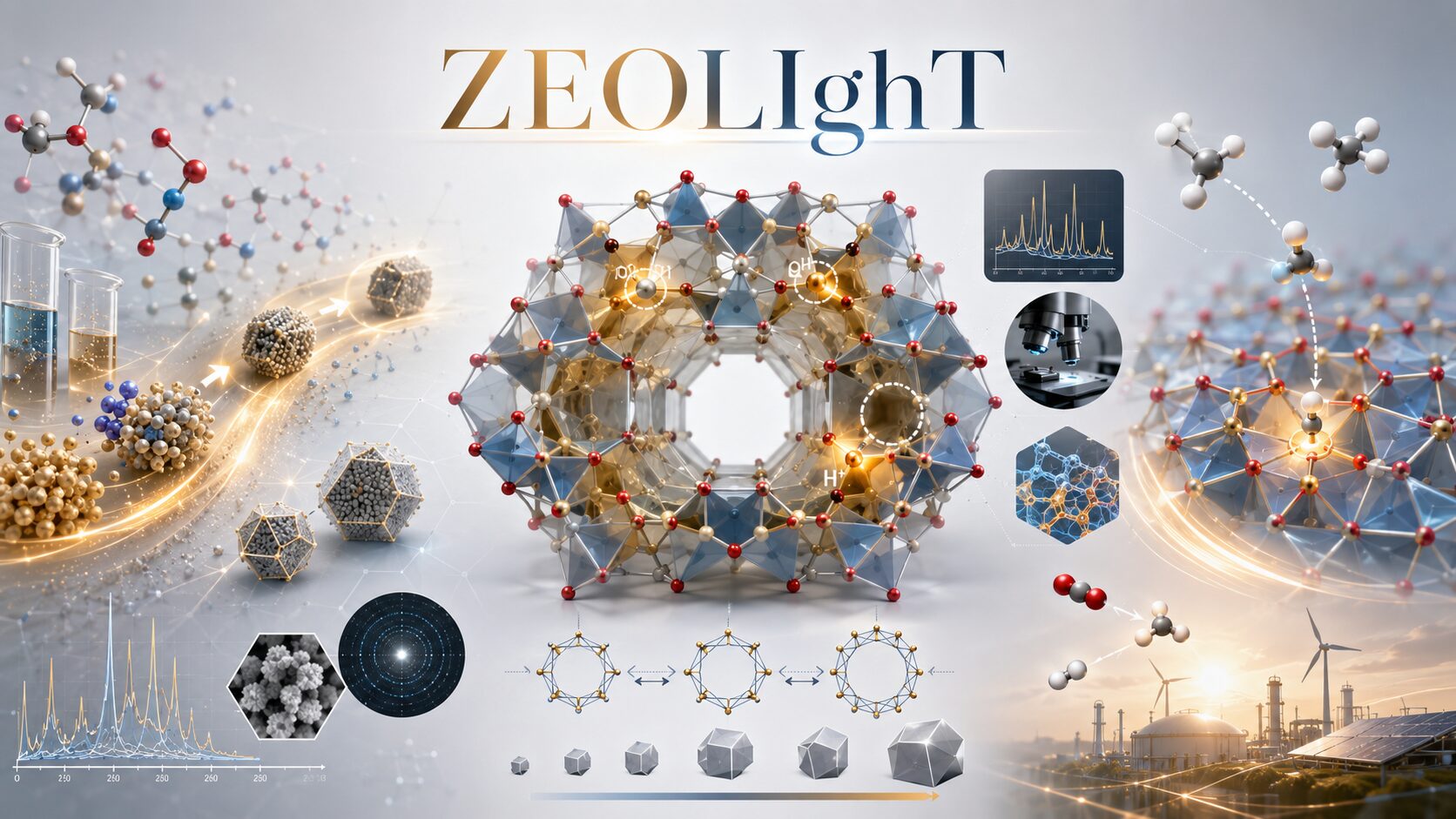
The aim of ZEOLIghT is to understand the fundamental molecular-level interactions leading to specific crystallization events of nanozeolites to direct their properties. The three challenges are: 1. rational formation of molecularly-ordered precursors with different tetrahedral (T)-atoms, understanding the fundamentals of zeolite growth kinetics in colloidal and high solid precursors resulting in frameworks with controlled defects and flexible structures (Fundamental understanding of defects and flexibility of nanozeolites), 2. translate the discovery at the atomistic scale to development of novel nanozeolites and fine-tuning of relevant properties including crystals size, pore dimension, framework structure, bulk chemistry, and stability (Engineering nanozeolites), and 3. relate the defects and flexibility as the origin of the remarkable properties of ultra-stable zeolites for applications in heterogeneous catalysis: the selection of the non-oxidative conversion of methane reaction as a specific case, but not limited to, will be considered (Application). The mysterious “defects” associated with the generation of various silanol species, Brønsted acid sites, and vacancies as integral parts of the reaction center of zeolites and their relation to the framework flexibility will be elucidated by advanced characterization.
The ZEOLIghT project will be the fundamental scientific driver for seeking novel nanozeolites and fully realize the knowledge gained in global cases where porous materials are considered. The key achievements are understanding the properties of nanozeolites by uncovering the consequences of defects and flexibility. The nanozeolites will claim a sizeable share of the global zeolite market for both classical and emerging applications.
Résultats
The ZEOLIghT project has made significant advances in zeolite synthesis, characterization, and application, surpassing existing methodologies and expanding their industrial relevance. In situ visualization of nanozeolite flexibility was achieved, revealing their dynamic response to external stimuli such as CO2 adsorption under elevated temperatures. Nanozeolites with precisely controlled defects demonstrate superior catalytic performance, reducing coke deposition and extending catalyst lifetime. Flexible nanozeolites have exhibited unmatched efficiency in CO2 capture, presenting viable solutions for industrial carbon capture.
Industry collaborations with Total Energies and Petro China underscore the commercial potential of ZEOLIghT’s innovations.
To ensure the full impact and market adoption of ZEOLIghT’s breakthroughs, the following steps are crucial:
Scaling up promising nanomaterials via high-throughput robotic synthesis and exploring new catalytic applications.
Transitioning from laboratory – to – large scale production, including start-up creation and strengthened industry partnerships.
Securing intellectual property rights (IPR) and aligning with regulatory frameworks to accelerate market adoption. Patents already have been filed on the synthesis of nanozeolites for CO2 and H2O adsorption/separation.
The CLEAR Center for Zeolites and Nanoporous Materials, where the ZEOLIghT project is developed provides a strategic platform for advancing these efforts.
Summary of Key Achievements
Publications: 16 published papers in high-impact journals.
Presentations: 14 plenary/keynote lectures, 30 oral contributions by students and postdocs.
Awards: 2024 Les Étoiles de l’Europe, 2024 Flanigen Lecture Award, 2023 GFZ Honorary Award, 2024 Paris Olympics Torchbearer.
The ZEOLIghT project has redefined nanozeolite research with advancements in synthesis, characterization, and applications.