MACADEMIA
Description
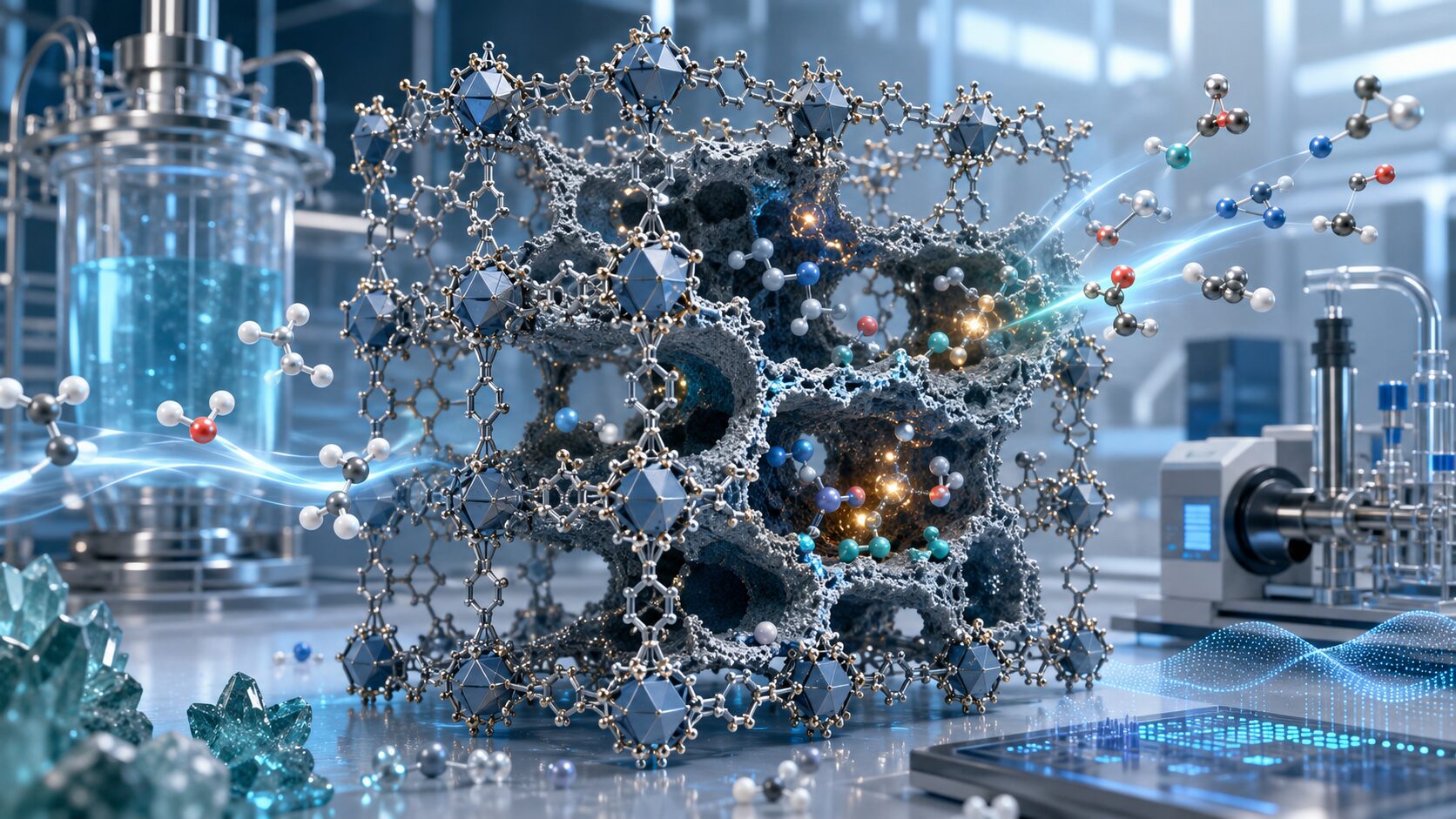
A major challenge facing European industry involves the development of more specific, energy saving processes with less environmental impact. The recent development of Metal Organic Frameworks (MOFs) may prove a major milestone in achieving these goals. MACADEMIA project is an extension to an FP6 STREP (DeSANNS) which highlighted some MOF materials for CO2 capture and storage. It will expand and continue this work on a much larger scale. The three Total branches will focus on bringing MOFs to key market sectors – gas separation and storage, liquid separation and catalysis. The Total-led consortium, with 11 academic partners from across EU, one leading South Korean partner, among world leaders among their particular domain of MOF science, will be contributing to the project, with a dedicated management partner. MACADEMIA intends to produce new MOFs and optimise those already of promising interest, characterise MOFs using specialised techniques, test MOFs using a three-tiered process, use predictive modelling and demonstrate the use of MOFs in key industrial processes. It will target separation processes in gas / vapour phase (propene/propane, acid gases separation, CO2 and H2 purification), in liquid phase (xylene separations, recovery of N- and/or S-compounds from hydrocarbons), and in catalysis (Lewis-acid MOFs as catalysts for epoxide polymerization, redox-active MOFs as catalysts for hydrocarbon autoxidation). Several of MACADEMIA’s targets are expected to reach pilot scale whereas a blue sky approach will be taken for others giving room for innovation and step change. An attractive project, it is open to young researchers with industrially coordinated research to counterbalance competition from USA and Japan and able to contribute to a strong ERA.
Objectifs
A major challenge facing European industry involves the development of more specific, energy saving processes with less environmental impact. The recent development of Metal Organic Frameworks (MOFs) may prove a major milestone in achieving these goals. The MACADEMIA project is an extension to the FP6 project DeSANNS, which highlighted some MOF materials for CO2 capture and storage. It allowed expanding MOF synthesis on a much larger scale, as well as multiple applications. TOTAL’s focus is on bringing applications of MOFs to key market sectors -gas separation and storage, and liquid separation. The TOTAL-led consortium, with Total Petrochemicals and Refining-Marketing as industrial partners, 11 academic partners from across EU, one leading South Korean partner, among world leaders in their particular domain of MOF science, contributed to the project, with a dedicated management partner.
The main objectives of the MACADEMIA project are:
– production of new MOFs and optimisation of those already of promising interest;
– characterization of MOFs using specialised techniques,
– use of predictive modelling for gas- and liquid phase applications, with Grand Canonical Monte-Carlo and Moleculr Dynamics tools,
– testing MOFs in a wide range of applications, such as gas and vapour recovery and separation (propene /propane, acid gases separation, CO2 and H2 purification), liquid phase adsorption and separation (xylene separations, recovery of N- and/or S-compounds from hydrocarbons), catalysis for specialty chemicals (Lewis-acid MOFs as catalysts for epoxide polymerization, redox-active MOFs as catalysts for hydrocarbon autoxidation).
Résultats
Three projects partners (FEUP, TOTAL, and KRICT) filed a patent for a process, aiming the recovery of nitrogen or recovery of nitrogen and propylene using MIL-100(Fe) shaped material. The patent is titled “Procédé cyclique de production d’azote de haute pureté et éventuellement d’hydrocarbure de haute pureté à partir d’une charge contenant de l’azote et un hydrocarbure.”, having as inventors F. Luck, C. Leroi, A. Fernandez, A. M. Ribeiro, J. C. Santos, A. E. Rodrigues, J-S. Chang, U- H. Lee, Y-K. Hwang, J-P. Bonne, Patent Application PCT/FR2012/051623, filled on July 9, 2012.
An exploitation seminar was held in Brussels, June 13th, with 13 participants from 9 organisations, animated by Salvador Pastor, ESIC2 Services. At the present moment, only two Exploitable Results had been clearly identified:
● Synthesis optimization and shaping of new MOF materials.
● Workshop / Training Module on MOFs: from synthesis to applications.
It is expected to have specific results for additional MOFs from partner TOTAL within a few months (January 2014); at that time, more relevant Exploitable Results may appear, and a second version of this ESS Report could be delivered with complete new sets of Contribution-Benefit Matrices,